
Solar Survey Day on a Dairy Farm: What KMM Actually Does On Site
The 'solar install or dairy farm internship?' KMM short — 29 seconds of what a typical dairy farm survey looks like. The full walkthrough below: what we measure, what we ask, what to expect.
The 29-second video that explains a survey day
KMM's surveyors are field-based. A typical day during the spring quoting season involves three or four farm visits, often across different counties. This video — KMM's third-most-watched at 1,300+ views — shows what a dairy farm survey actually looks like.
What KMM measures during a dairy farm survey
A typical dairy farm survey takes around 90 minutes on site and captures the following data:
- Roof geometry — drone capture of every available roof surface; 3D model with pitch angles, surface area, vent and ridgeline obstructions
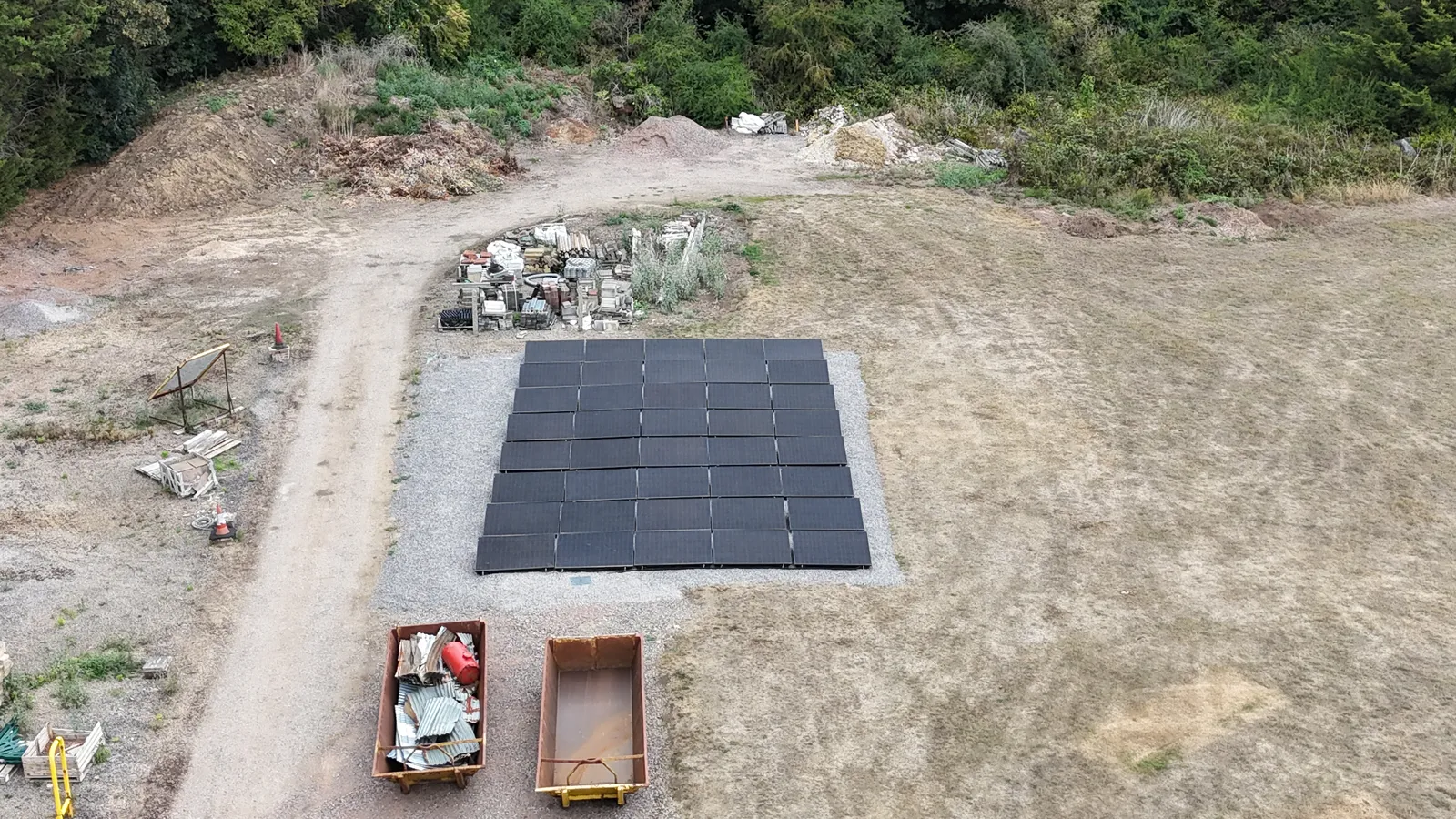
- Ground-mount opportunity — adjacent paddocks, hardstanding, marginal land suitable for sheep-grazed ground-mount
- Existing electrical incomer — supply rating (typical UK farm is 100 A or 200 A single-phase, 100-300 A three-phase for larger ops)
- Half-hourly meter — if HH-metered, we pull 12 months of data; if not, we install a temporary clamp meter
- Parlour cycle pattern — milking times, refrigeration on/off pattern, ventilation runtime
- Diesel usage — generators, grain dryer (if mixed arable), irrigation pumps — for battery-displacement modelling
- Building condition — roof material, age, fixing detail, asbestos check on older sheds (1960s-70s buildings)
- DNO context — local 11kV network capacity, distance to nearest substation, voltage rise risk
What KMM asks the farmer
Beyond the physical survey, the farmer-facing conversation is structured around five questions:
- What are your operations across the year? Some farms have a steady weekly profile, others spike heavily around lambing, harvest, or calving.
- What are your retail customers' net-zero requirements? If you supply a major UK retailer (Tesco, Sainsbury's, M&S, Waitrose), they likely want documented Scope 2 reductions. Solar PV is the cheapest way to provide them.
- How is the farm structured? Sole trader, partnership, limited company, mixed family arrangement — each has different tax implications for capital allowances such as AIA.
- What's your planning history? If you've had ground-mount or wind applications refused, that affects the planning route we'll recommend.
- What's your timeline? Most farm decisions are seasonal — winter for planning, spring for install, harvest blackout, autumn for commissioning.
What the survey delivers (free, no obligation)
Within 48-72 hours of the survey, the farmer receives:
- 3D roof model with proposed panel layout
- Shading study modelled across every hour of the year (Helios 3D)
- System size and capex range (typically two options — a smaller "safe" size and a larger "max-out" size)
- ROI cash model with all four assumptions disclosed (self-consumption, tariff, inflation, tax position)
- Finance routes side-by-side: CAPEX, asset finance/lease, PPA, Salix (if public sector applicable)
- Grant eligibility check (Lincolnshire RBG, D2N2, Notts Net Zero, etc.)
- DNO desktop check on grid capacity
What the survey doesn't deliver
Three things that come later:
- The G99 application — submitted after contract signature
- The structural engineer's report — commissioned only if the roof is borderline on imposed-load capacity
- The planning application — required for ground-mount above 9m², commissioned post-survey if you decide to proceed
If you're a dairy farmer (or any farmer) curious what a KMM survey looks like for your site, request one — they're free, take 90 minutes, and there's no pressure to proceed at the end.
Request a Fully Funded Electrical & Structural Survey
Tell us about your roof, your bills and your goals. KMM runs a fully funded electrical & structural survey, designs a system, runs the numbers and tells you honestly whether solar makes sense for you. No deposit, no pressure.
Fully Funded Survey → 0115 647 3822