
Agricultural Solar Survey Guide — What a Real Farm Survey Looks Like
UK farmers get pitched solar by aggressive door-knock crews offering on-the-spot pricing with no survey, no data, no engineering. This is what an actual agricultural solar survey looks like — what we measure, what we model, and what you walk away with.
Visit 1 — The HH data + farm operations audit (no solar talk)
The first KMM visit on a working farm doesn't mention solar. We need three things:
- 12 months of half-hourly meter data from your supplier — pulled before the visit (we'll guide you through the MOP request, takes 7 days).
- Operations walk — milking parlour, grain dryers, refrigeration, automatic feeders, parlour lighting, robotic systems. Every load that runs.
- Seasonal demand profile — silaging week vs lambing week vs harvest. Demand on a dairy farm at 04:30 is 3x demand at 14:30.
The output is a baseline kW load curve with seasonal overlay. Often we identify 18-26% wasted demand the farmer didn't know was happening — leaky compressed-air on a parlour, immersion-heater contention, controlled pumping schedule wrong. Fix that first.
Visit 2 — Structural + drone roof survey
Second visit brings a CAA-certified Remote Pilot and (if needed) a structural engineer.
- Drone flight 18-25 min: high-res capture of every roof panel, ridge, valley, hip. Output is a 3D model with shading analysis.
- Structural assessment: old asbestos cement roofs (pre-1999) get an asbestos register check. Old portal-frame buildings (1960s-80s) get a structural load calc before any panels are committed.
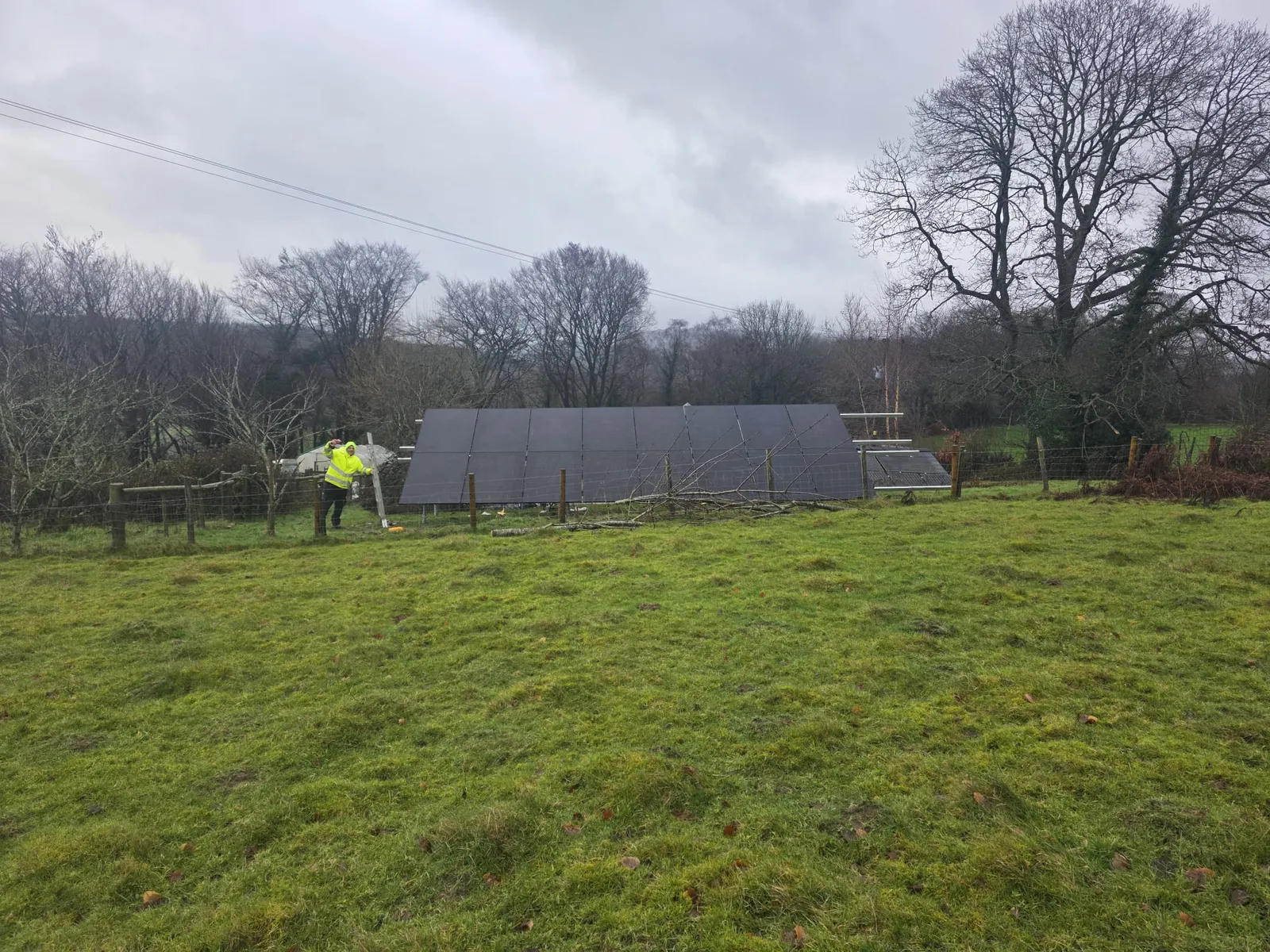
- Ground-mount option survey: if roof is unsuitable or insufficient, we walk available paddock and stubble fields. Planning, grant eligibility, sheep-grazing co-location all factored.
Visit 3 — Bound proposal walk-through
Six to eight weeks after Visit 2, we sit with you (and your accountant if available) and walk you through the bound proposal — honest numbers, with any farm grant that is open for you mapped in.
- System design: exact panel layout (Aiko, JA Solar or Perlight panels typically; Sigenergy, Solax or Fox inverters)
- NGED (formerly Western Power Distribution) G99 capacity check — we'll have done a pre-application by this point
- Financial model: Capex + AIA, Barclays Green Cashback, asset finance, Improving Farm Productivity grant — 4 routes compared
- Programme: install dates, weekly milestones, hand-off date
- Warranties: 25yr panels, 12yr inverters, 5yr workmanship
Farm solar grants — what every UK farm should know in 2026
England's farm solar grant is the Improving Farm Productivity scheme — a 25% contribution towards solar PV. Key facts:
- Contribution rate: 25% of eligible costs (England)
- Grants of 25-40% available by UK nation — Scotland, Wales and NI run their own schemes
- The FETF (Farming Equipment and Technology Fund) covers listed productivity equipment items — solar PV is funded via Improving Farm Productivity, not FETF
- Application windows are periodic — check the current round before commissioning design
- Cannot stack with other public funding for the same item
If you are within an application window, we time the survey + bound proposal to land before submission deadline. Read the full farm grants deep-dive.
Real numbers — KMM farm install 2024
Lincolnshire arable farm, 145 kWp ground-mount + 80 kWh battery + grain-dryer integration. Project value £142,800. Farm productivity grant secured £24,800. Net capex £118,000. Year-1 generation: 142 MWh against modelled 138 MWh (2.9% over). Bill saving: £28,400/yr + £4,200 SEG export. Payback tracking at 4.4 years. Full case study →
Book a fully funded farm survey
3 visits, 8 weeks of analysis, bound proposal. Farm grant route checked (Improving Farm Productivity). No high-pressure sales. £0 to you.
Request a Fully Funded Survey → 0115 647 3822